Urban Consulting Group International
Planning for Humans™
A major programme is planned by humans, built by humans, operated by humans and used by humans.
Almost every methodology in the industry has replaced all four with a document.
Urban CGI is a specialist planning practice. We support engineering in complex physical and stakeholder environments, working with the directors of large capital programmes across the life cycle, and we measure ourselves on decision latency — the time between a question arising and an answer everyone will act on.
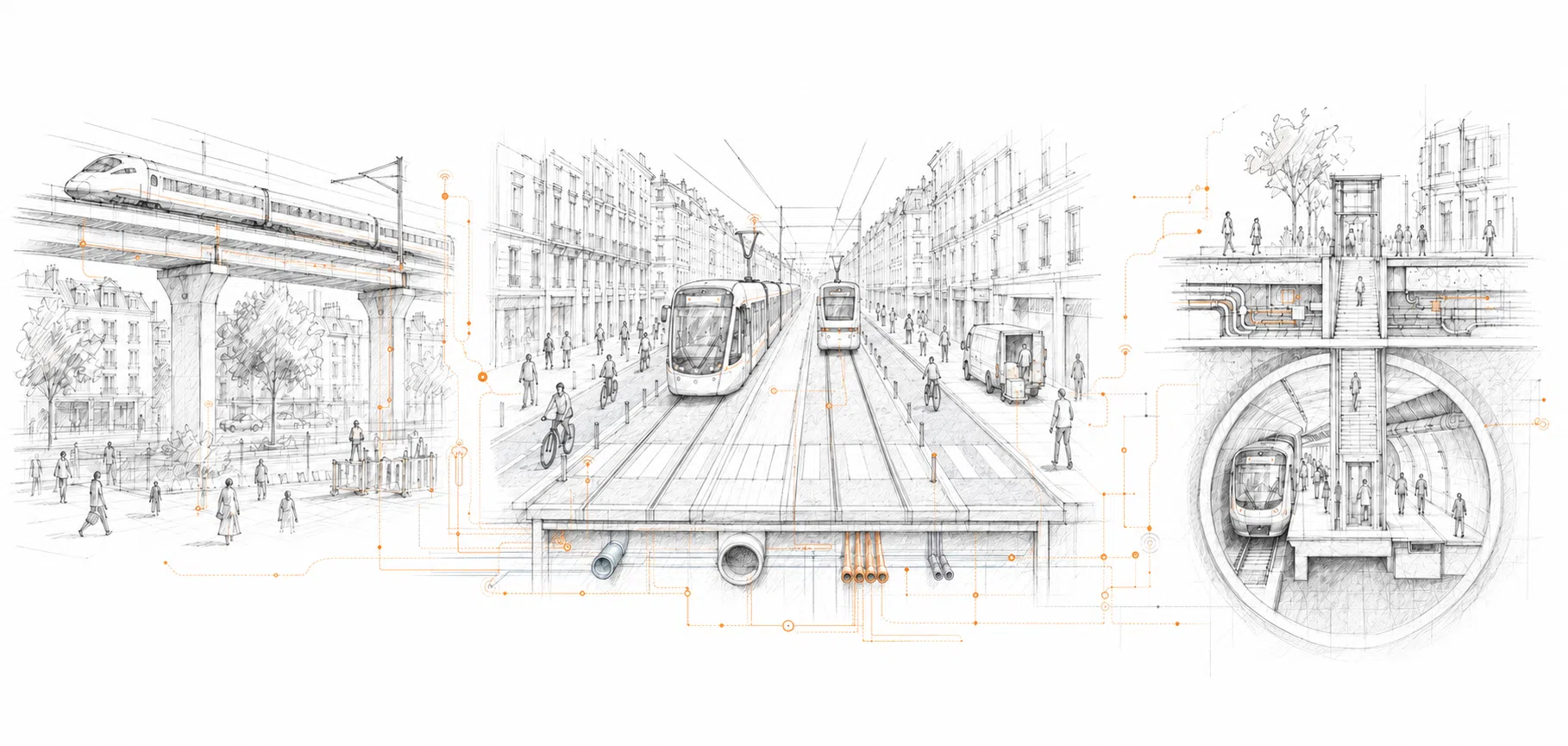
Planning for Humans
One name, working many ways at once.
Human factorspsychology · integration · communication · empathy · process · culture · competence · shared understanding
- 01
Planned by humans
The planners, engineers and designers in the room, whose assumptions become everyone else’s constraints.
- 02
Built by humans
The crews who perform the sequence, from a document, in a place still to be built.
- 03
Operated by humans
The drivers, controllers and station staff who will run the asset for fifty years after the ribbon.
- 04
Used and maintained by humans
The passengers, residents and public who experience it, and the workers who keep it running for decades after handover.
Each of the four is a human system. Industry methodology has replaced all four with a document. Planning for Humans is the work of putting them back.
A programme has technology, systems, plant, concrete and steel, and every one of those is well served. It also runs on psychology, communication, empathy, culture, process, competence, understanding and integration. Those are the difference between a poor project outcome, a good one, and a great one.
A programme is planned by humans, built by humans, operated by humans and used by humans. Industry methodology has a method for the concrete.

Where the method comes from
CGI Planning began in doctoral research into engineering-driven reconstruction, and has been applied commercially since 2004 across urban planning, minerals and mining, and major transport — heavy rail, roads and light rail.
The research question then is the operating question now: how large works meet the ground, and the people on it, with intent. Everything since has been instrumentation for answering it faster.
OriginDoctoral research, United Kingdom. Applied in practice from 2004.
SectorsUrban planning · minerals and mining · heavy rail, roads and light rail
Methodology
Engineering in the private sector has amalgamated into ever larger organisations, and the results of that are now well studied. Bent Flyvbjerg’s work across thousands of programmes establishes cost and schedule overrun as the norm rather than the exception, and the consenting picture moves the same way — time to a decision on a Nationally Significant Infrastructure Project rose from 2.6 years in 2012 to 4.2 years in 2021. Our reading of that evidence, with sources, is set out in Engaging the workforce to deliver the programme.
Three systems are in play against that backdrop.
ReferenceFlyvbjerg & Gardner, How Big Things Get Done, 2023. Chapter 1 Think Slow, Act Fast. Chapter 4 Pixar Planning.
ConsentingNSIP decision times: 2.6 years in 2012, 4.2 years in 2021.
- 01
The engineering system
Absolutist, and perfectionist, and right to be. It is physical: things stand up, hold, and meet tolerance, and design engineering fixes properly on the outcome — the finished asset. All of it stays exactly as it is.
- 02
The planning system
Squidgy around the edges, because its variables are people. Getting from the surveyable world as it is to the asset as designed takes an enormous number of actions that must coordinate and coexist, which makes psychology a working tool rather than a flourish.
- 03
The CGI planning system
Ours. A combination of psychology, technology, culture, speed and service, built to facilitate the engineering conversation itself. The technology carries the load and stays in the background, where it belongs. Flyvbjerg gives Chapter 4 of How Big Things Get Done the title Pixar Planning: model it, rehearse it, revise it while revision is cheap, then build once. CGI Planning is that method carried into infrastructure. The long version is in Pixar planning, CGI planning and engagement.
From diagrams to rehearsal
The change a programme actually feels is in the room. Meetings stop being CAD extracts, slides and PDFs, and become a live rehearsal of the work — running, interrogable, on whatever screen is already in the room. Everyone in one medium, at the same moment, with the plan itself in front of them.
It works for a reason that sits well away from graphics. People take their cues from what they watch other people do; the mechanism is well documented and the film industry has relied on it for a century. Put the humans who will operate, drive, decide, lead, build and walk past inside the drawing, and behaviour changes in a way no briefing achieves.
Many have tried this with standard industry technologies and run into the same wall: the speed, accuracy and fidelity fall short of answering a question while the question is still live. A programme director needs the answer now. Twenty-seven meetings, ten people, four months — do the arithmetic on what a deferred decision costs.
The rest is unglamorous and matters just as much: getting people inside the same organisation to talk to each other about the same thing. Together the two take arguments that ran for months and settle them in minutes.
Coined termThe enactment gap — the distance between an approved plan and the coordinated behaviour of the people who must perform it.
CultureTransparency and empathy run alongside the linear disciplines, deliberately. Both halves or neither.
Next generation planning gets everyone on the same page, in the same medium, in real time.

On tools
We work at the cutting edge of CGI and artificial intelligence, and we hold both lightly. They sit in the same category as a pen, a survey and a spreadsheet: instruments, earning their place by what comes out the other end.
The toolset moves week by week at present, and we move with it. What we ask of it holds steady — more efficient, more reliable, better quality, safer. Each of those is measured on the people who plan, build, operate and use the thing.
PositionTechnology as means. Outcome as the measure. Humans as the point.
The tools change weekly. What we ask of them holds.
CGI Planning
CGI Planning puts the human into the plan. The driver. The slinger. The banksman. The operative, the supervisor, the signaller, the crew. Where their hands go, how they communicate, what plant is in the way, how much space they actually have, and how they get through the sequence efficiently and effectively.
Much of it is pre-engineering work: the questions answered before and around the engineering, which decide whether the plan survives the ground it meets.
The consistent finding, across every sector we work in, is what teams discover about their own method once they have to rehearse it. They find things that had escaped every review. Then they find out how fast they can actually go. The competency side of that argument is worked through in route competency and operational readiness.
PositionAn integrated planning practice.
Every team that rehearses its own plan finds something new in it. Then it finds out how fast it can really go.

Across the life cycle
Six places we are brought in. Programmes rarely buy all six, and the ones that do tend to buy them in this order.
- 01
Design development and optioneering
Getting to the right option faster, and showing why it is the right one to people who read drawings for a living and to people who read them once.
- 02
Approvals
Turning an assessment conversation that takes months into one that takes minutes, because everyone in the room can see the same thing.
- 03
Engaging the workforce
The internal workforce and the supply chain. A change in what people actually do, rather than a communications campaign.
- 04
Simulating the outcome
Rehearsing sequence, interface and human behaviour so a method fails while failure is still cheap.
- 05
Operational readiness
Proving that the people who will run the asset can run it, before the asset is handed over rather than after.
- 06
Delivery
Operating procedure a crew can perform, validated, verified and proven, and held current as the works change.

The problems we are called in for
In our clients’ words rather than ours. Clients arrive with one of these rather than with a request for simulation.
NoteProgrammes rarely present with one of these alone. They present with nine, and no agreed order.
Time
- Optioneering delays
- Approvals, internal and external
- Slow plan review cycles
- Slow test-and-learn
- Track and possession access
Cost
- Rework and rebuilds
- Consultant variations
- Over-engineering and gold plating
- On-site workarounds
- Temporary works inefficiency
Coordination
- Integration across disciplines
- No shared understanding
- Stakeholder buy-in
- Management of change
- Complex method statements
Risk and reputation
- Unforeseens
- Plan Bs and Cs
- Incidents and high-potentials
- Operational readiness
- Reputation
What it is bought for
Four outcomes. Every engagement is measured against at least one of them, and the first three are auditable.
- —
Less rework
Errors found in a rehearsal cost a meeting. The same errors found on site cost a programme.
- —
Fewer delays
Most of what stops a front comes down to a sequence performed for the first time, or a competency that arrived late.
- —
Better integration
Between disciplines, between contractors, and between the people building the asset and the people who will run it.
- —
Reputation
The one that stays out of every scope and lands on the director personally.
Who we work with
Project and programme directors who already hold a particular view: that humans belong in the plan alongside the concrete, the pipes and the yellow plant. The people who will build it, run it, maintain it and use it. Leave them out and most of the plan is missing.
They tend to hold a second view as well — that a plan is a moving thing, seen from a hundred viewpoints rather than one, and that integration in the modern world has become complex enough to demand instruments equal to it. Working a programme of this scale on static documents is flint-knapping.
Sectors: heavy and metropolitan rail, major stations and interchanges, road and tunnelling, nuclear and energy, water and utilities, minerals and resources, defence.

The people
A broad sweep of specialist practitioners, typically multidisciplinary by nature, working across five areas.
- —
Spatial and technical modelling
Reading engineering documentation and building accurate, dimensionally correct environments from it.
- —
Software and simulation engineering
Real-time systems, agent behaviour, pipeline and platform.
- —
Human performance and animation
Credible human figures performing real procedures, which is what makes a sequence learnable.
- —
Learning delivery and ICT
Getting modules to a distributed workforce and keeping the record of who has proven what.
- —
Commercial and programme
Contract, scope and the discipline of delivering to it.
Leadership
Dr Ben Guy — Founder and Director. Physicist, behavioural scientist and doctor of planning. Twenty-five years focused on planning for humans in complex projects and environments, across the life cycle.
Urban CGI — Urban Consulting Group International
A part of the Urban Group, including Urban CGI UK, Urban CGI Australia and Urban Circus
United Kingdom and Australia
Twenty-five years on the same problem